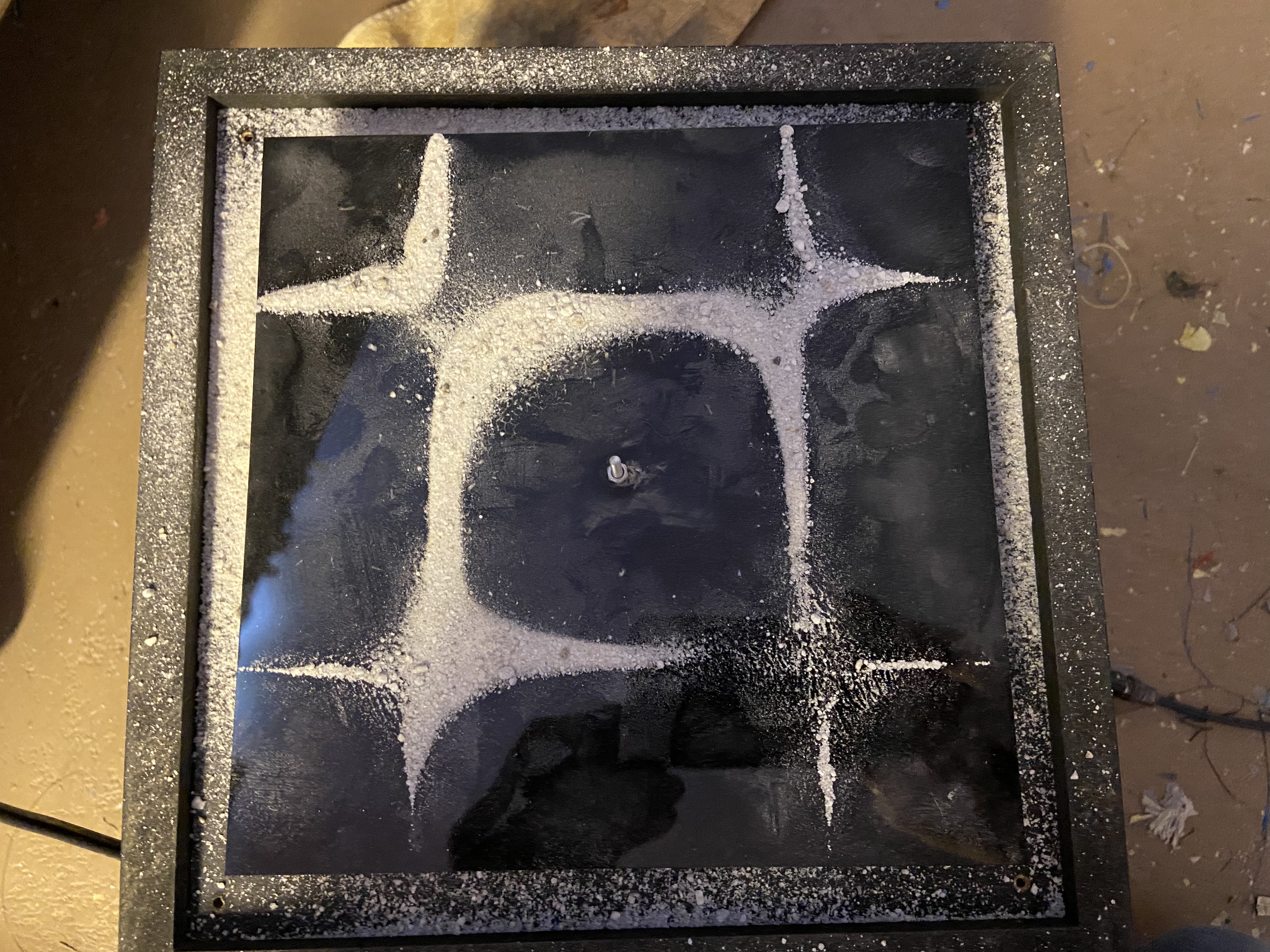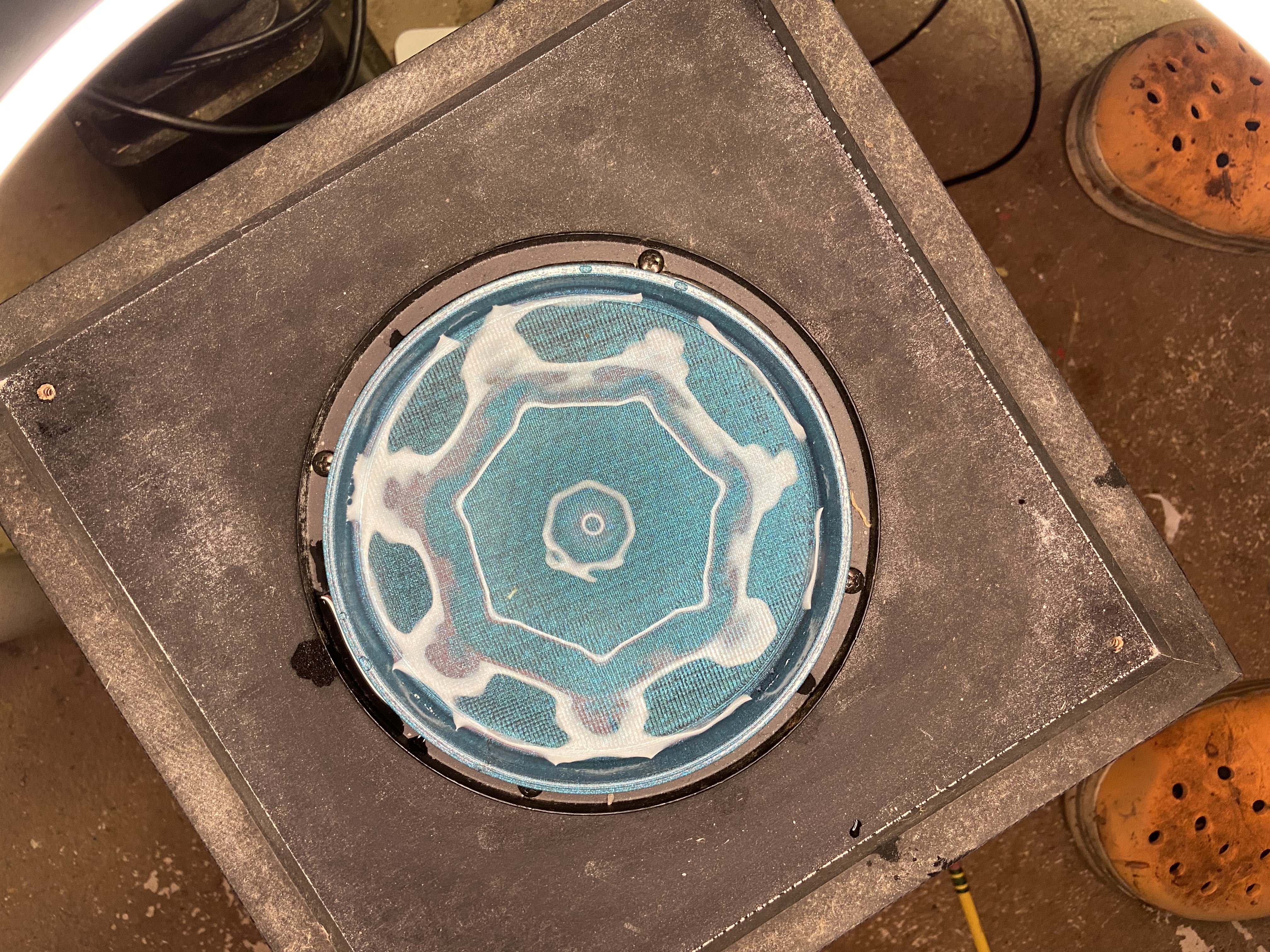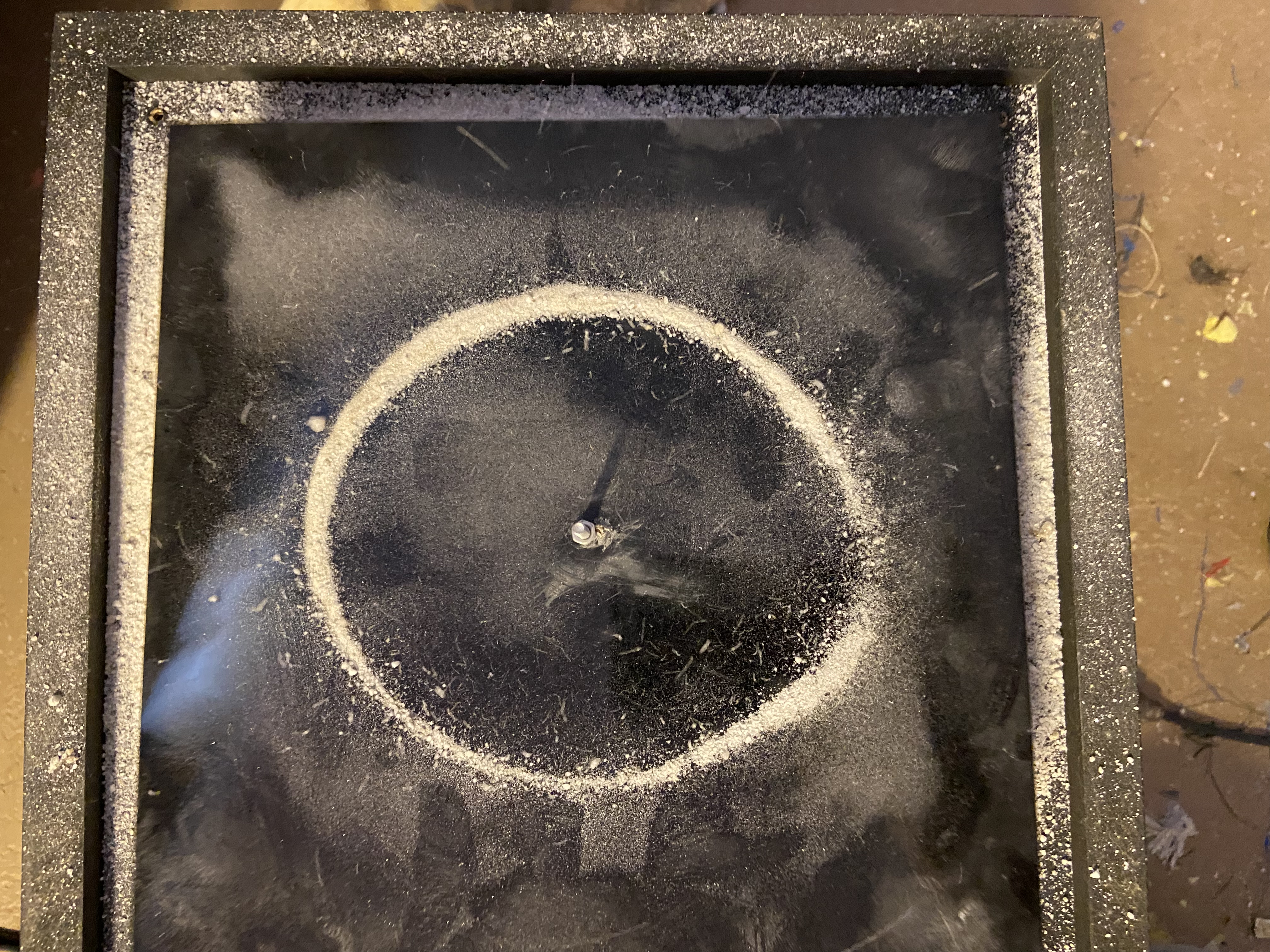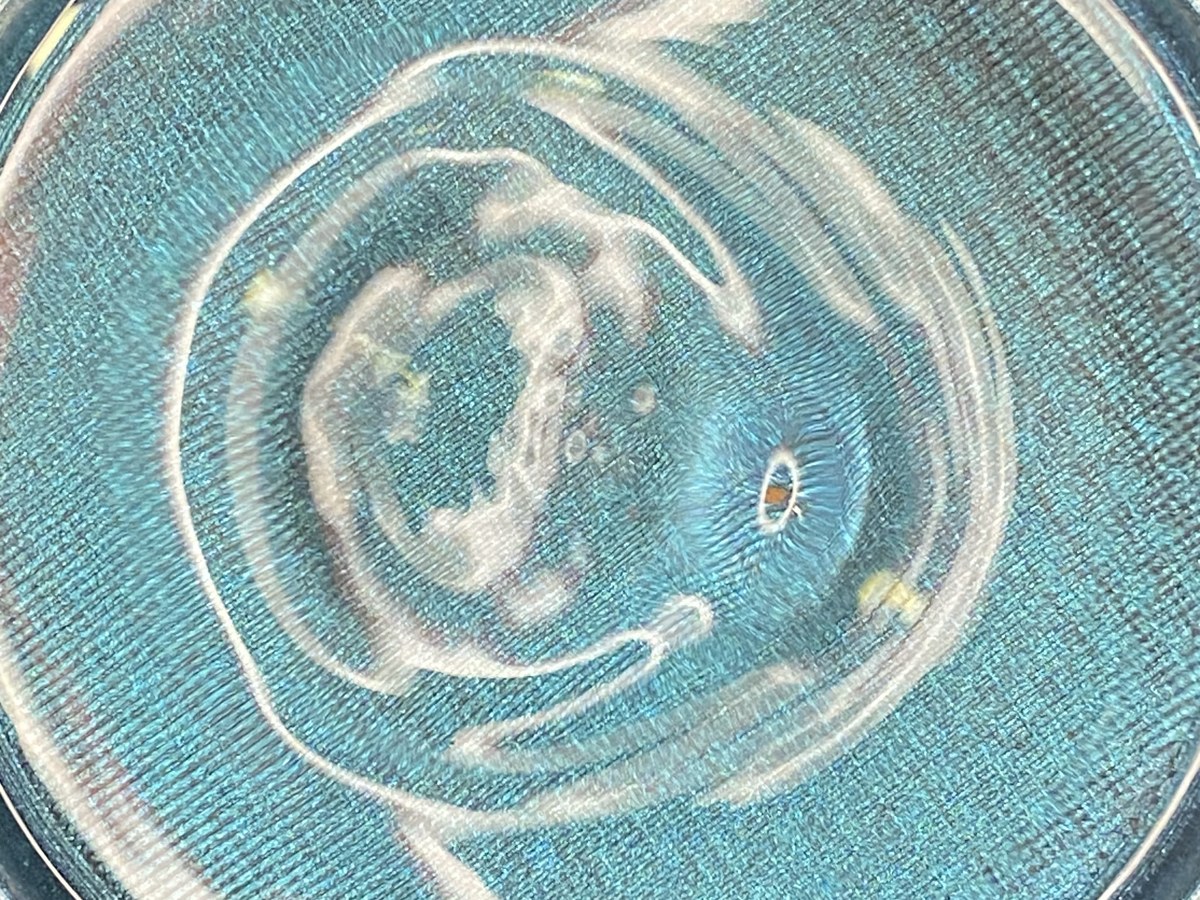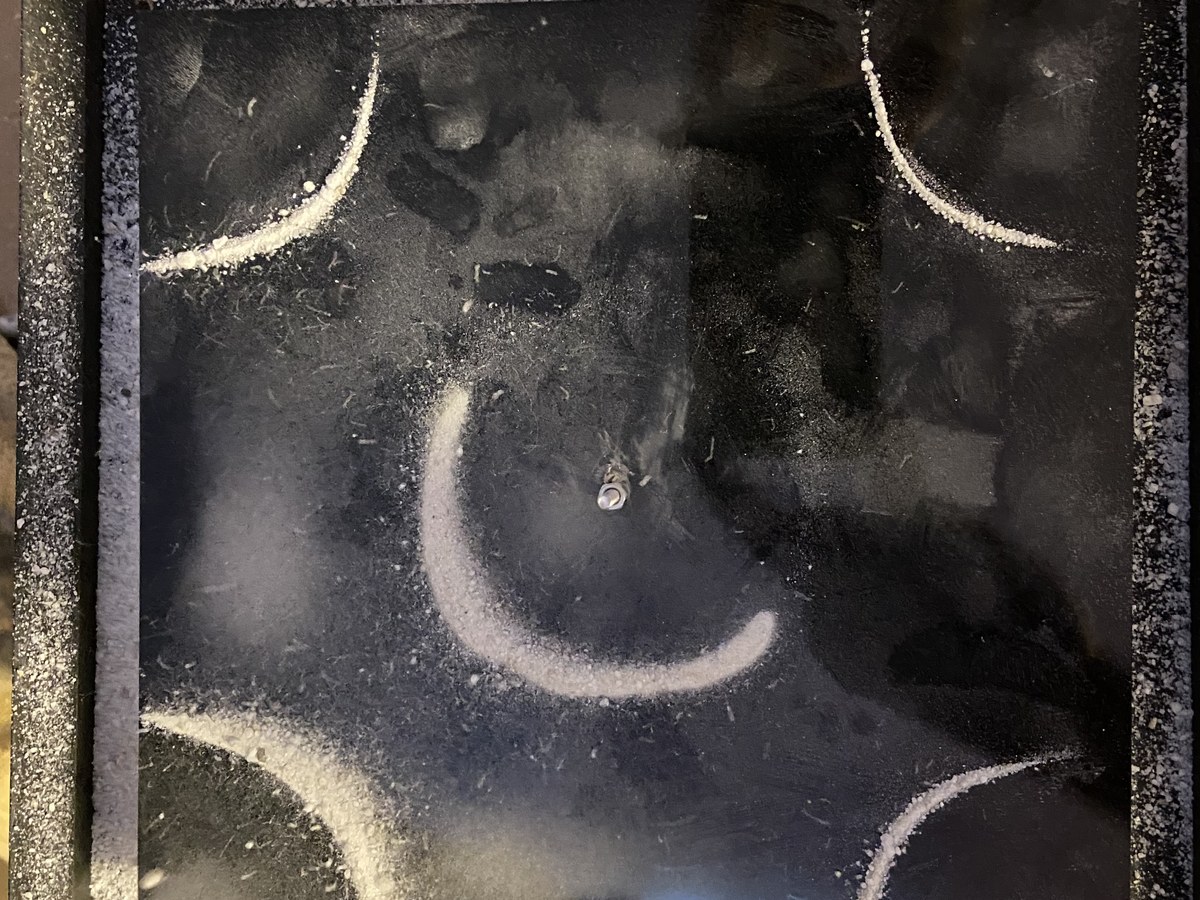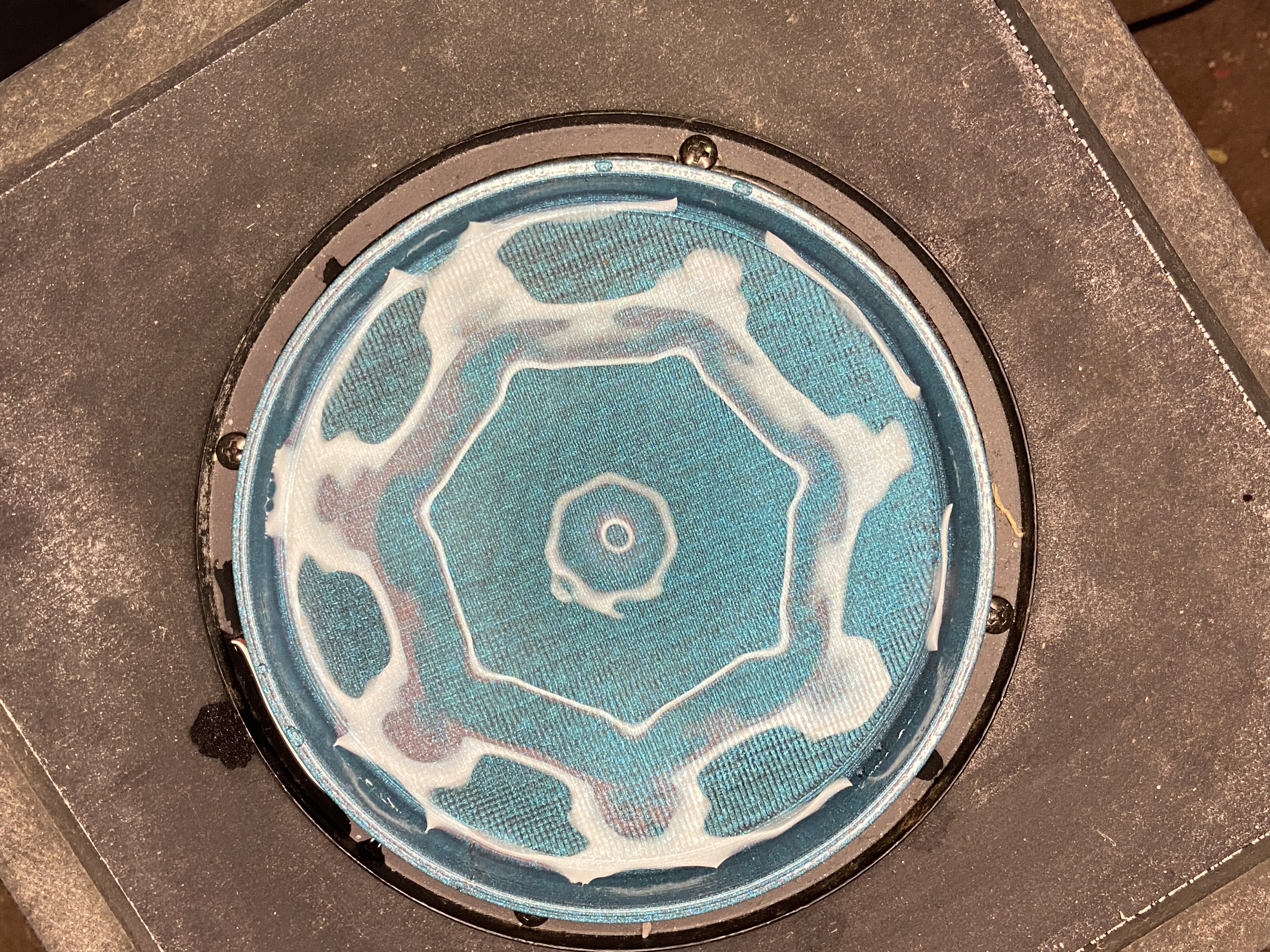
Sand on a metal plate. Tone generator underneath. Dial up the frequency until it hits a resonance — the sand jumps off the vibrating parts and piles up where it's still. The plate draws its own portrait. September.
Ernst Chladni discovered this in the eighteenth century using a violin bow on a glass plate dusted with sand. He drew the patterns by hand and catalogued them — the first systematic documentation of modal shapes in resonating surfaces. The patterns are now called Chladni figures, and they are the visible record of the plate's natural frequencies: the specific tones at which it prefers to vibrate, the geometries that emerge when it's allowed to do what it does.
The physics is standing waves. At a resonant frequency, the plate vibrates in a specific pattern of nodes and antinodes. Nodes are the points that don't move — the boundary conditions where the standing wave is always at zero amplitude. Antinodes are where the motion is greatest. Sand, being subject to gravity and the lateral forces from the vibrating surface, migrates away from the antinodes and accumulates at the nodes. What you see in the photograph is the nodal geometry of the plate at that frequency, drawn in sand.
The setup: a steel plate clamped at its centre to a speaker driver driven by a function generator. The function generator sweeps frequency. At non-resonant frequencies, the sand bounces chaotically. At resonance, the chaos resolves, suddenly and completely, into a figure. The transition is abrupt — one moment disorder, the next a perfect octagon or star or asymmetric tangle, depending on the frequency and the geometry of the plate.
Both square and round plates were used. The square plate produces figures with fourfold symmetry at most frequencies. The round plate produces figures with more varied symmetry — some with sixfold, some with eight, some with asymmetric modal patterns that suggest the plate has imperfections the mathematics can see and the eye can't. Blue pigment powder was used for the indoor shots; fine white sand for the larger plates. Both work. The physics doesn't care about the medium.
Most physics is invisible. Wave interference, resonance, field geometry — you calculate these things, you measure them with instruments, but you don't usually see them. Cymatics is one of the rare exceptions where the phenomenon renders itself visible without any intermediary. The sand is not representing the wave pattern — it is the wave pattern, the way iron filings are not representing a magnetic field, they are the magnetic field made visible. These are the moments where physics stops being abstract and becomes something you can photograph.